What Happens to Pesticides Before They Ever Reach the Field
When a farmer reaches for a jug of herbicide or insecticide stored through a humid Midwestern winter, the assumption is straightforward: the product inside is the same product that left the manufacturing facility. That assumption, while understandable, is frequently incorrect—and the chemistry behind why it fails has meaningful consequences for both agricultural outcomes and environmental health.
Pesticide degradation during storage is not a fringe concern confined to poorly managed operations. It is a systematic chemical reality that affects products across formulation classes, storage environments, and geographic regions. Yet it receives comparatively little attention in regulatory guidance, product labeling requirements, or on-farm training programs.
The Chemistry of Instability
All pesticides are, at their core, reactive chemical compounds. That reactivity is precisely what makes them effective against target organisms—but it also renders them susceptible to the same environmental forces they are designed to withstand in the field. In storage, the primary degradation mechanisms include hydrolysis, photolysis, oxidation, and thermal decomposition.
Hydrolysis is among the most common and consequential. Many organophosphate insecticides, for instance, are acutely sensitive to water and pH. When moisture infiltrates a storage container—even in trace quantities—it can initiate ester bond cleavage, breaking apart the active molecule into fragments that carry little or none of the original biological activity. The rate of this reaction accelerates significantly with temperature. An organophosphate stored at 90°F in an unventilated barn in Arkansas will hydrolyze at a meaningfully faster rate than the same compound stored at 60°F in a climate-controlled facility.
Pyrethroids present a different vulnerability profile. These synthetic compounds, widely used in both agricultural and residential pest control, are prone to photolytic degradation when exposed to ultraviolet light—a particular concern for translucent or lightly pigmented containers stored near windows or in open-sided outbuildings. Isomerization, a process in which UV exposure converts biologically active cis-isomers into less effective trans-isomers, can occur without any visible change to the product's appearance or odor.
Glyphosate-based formulations, which remain among the most widely used herbicides in the United States, introduce yet another dimension. While the active ingredient itself is relatively stable, many commercial formulations include surfactants and adjuvants that degrade at different rates. The result can be a product whose active ingredient concentration remains nominally intact while its delivery chemistry has deteriorated, reducing field performance in ways that no simple potency test would reveal.
Real-World Storage Conditions and Where They Fall Short
The gap between manufacturer storage recommendations and actual on-farm conditions is substantial. The label on most pesticide containers advises storage in cool, dry locations away from direct sunlight—guidance that is technically sound but practically difficult to implement across the diversity of American agricultural operations.
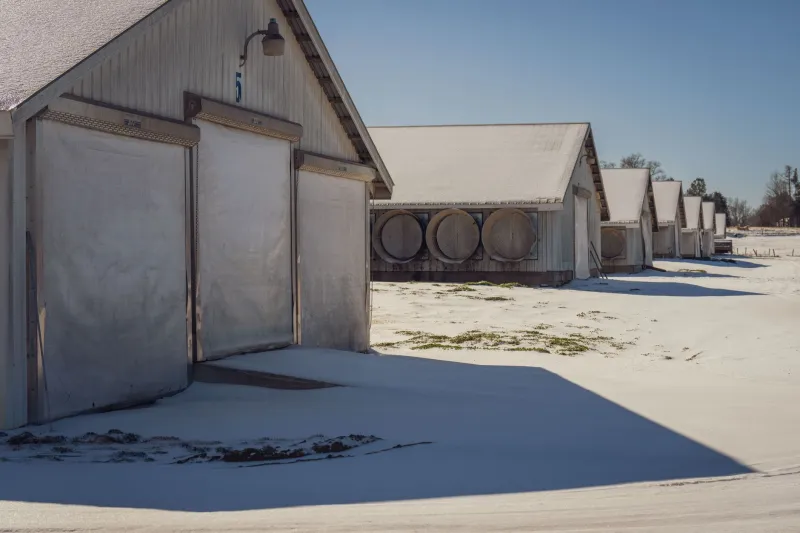
Many farms, particularly smaller operations in the Southeast and Great Plains, rely on metal outbuildings or repurposed structures for chemical storage. These spaces can reach temperatures exceeding 100°F during summer months and drop below freezing in winter. Freeze-thaw cycling is particularly damaging to emulsifiable concentrate formulations, which can undergo irreversible phase separation when subjected to repeated temperature extremes. Once an emulsifiable concentrate separates, attempts to re-homogenize it through agitation are often only partially successful, leaving the resulting mixture inconsistent in active ingredient distribution.
Container integrity compounds the problem. Pesticide containers are engineered to resist permeation and maintain seal integrity under normal conditions, but UV degradation of plastic containers, improper resealing after partial use, and physical damage during handling can all compromise that barrier. Partial containers—a common feature of farm chemical storage—are especially vulnerable because the headspace above the remaining product contains oxygen and, potentially, moisture that accelerates oxidative and hydrolytic reactions.
When Degradation Products Become the Problem
Perhaps the least appreciated dimension of pesticide storage degradation is the nature of what the original compound becomes. Degradation is not simply a subtraction of efficacy; it is a transformation of chemistry. The resulting breakdown products may carry toxicological or environmental profiles that differ substantially from the parent compound—and those profiles are rarely disclosed on product labels or addressed in EPA registration documents.
Chlorpyrifos, for example, degrades to chlorpyrifos-oxon under certain conditions, a metabolite with considerably higher acute toxicity to mammals than the parent compound. While this conversion is more commonly associated with in-field metabolism, analogous transformations can occur in storage under conditions of elevated temperature and humidity. Similarly, certain fungicide active ingredients can produce degradation products with endocrine-disrupting potential that the original compound does not exhibit.
The regulatory framework governing pesticide registration in the United States requires manufacturers to characterize the toxicology of major metabolites under field and environmental conditions. However, storage-specific degradation pathways receive far less systematic scrutiny. The implicit assumption embedded in most regulatory risk assessments is that the product reaching the application point matches the registered formulation—an assumption that degradation science increasingly calls into question.
Agronomic Consequences and the Attribution Problem
For farmers, the practical consequence of storage-related degradation is crop protection failure that is often misdiagnosed. When a pesticide application produces suboptimal results, the most common explanations pursued are resistance development, application timing errors, coverage deficiencies, or adverse weather conditions. The possibility that the product itself had lost meaningful potency before it was ever loaded into the sprayer is rarely investigated—in part because on-farm chemical potency testing is neither routine nor practically accessible for most agricultural operations.
This attribution problem carries economic weight. A farmer who incorrectly concludes that target pest resistance is responsible for a failed application may respond by increasing application rates, switching to alternative chemistry, or applying additional products—each of which adds cost and environmental load. The underlying cause, a degraded product, goes unaddressed.
University extension programs in states such as Iowa, Kansas, and North Carolina have begun incorporating storage chemistry into their pesticide applicator training curricula, but coverage remains inconsistent. Industry technical representatives, who often serve as the primary point of continuing education for commercial farmers, have limited commercial incentive to emphasize the finite shelf life of the products they sell.
Toward Better Practice and Better Policy
Addressing the pesticide storage degradation problem requires action at multiple levels. At the farm level, investment in climate-controlled chemical storage—while representing a capital cost—is among the most effective interventions available. Inventory management practices that reduce the accumulation of partial containers and aged stock can meaningfully limit degradation exposure.
At the regulatory level, there is a credible case for requiring manufacturers to include more specific stability data on product labels, including temperature-dependent shelf life curves and explicit guidance on the risks associated with freeze-thaw cycling or humidity exposure. The EPA's current labeling requirements do not mandate this level of specificity, leaving a significant information gap for end users.
For the research community, storage degradation represents a productive area of inquiry that sits at the intersection of analytical chemistry, toxicology, and agricultural science. Understanding which formulation types are most vulnerable, which degradation products carry the greatest risk, and how storage conditions can be practically improved would yield benefits for farm economics, human health, and environmental outcomes simultaneously.
The chemistry does not wait for the spray nozzle to open. It begins the moment a product leaves the production line—and every storage decision made between manufacture and application either preserves or erodes what reaches the field.