Beneath the Surface: How Pesticide Chemistry Reshapes the Microbial Communities That Drive Soil Health
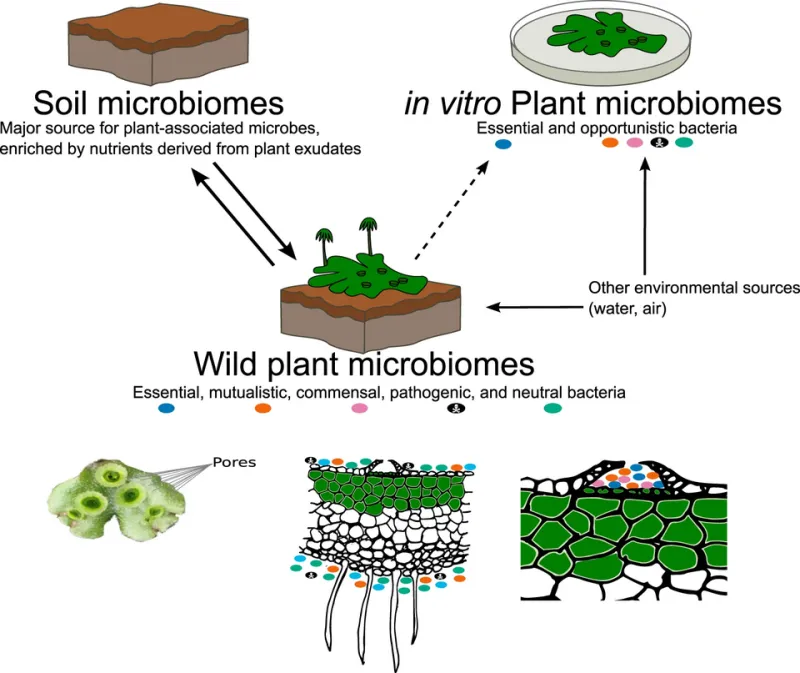
Photo: Luis D. Alcaraz, Mariana Peimbert, Hugo R. Barajas, Ana E. Dorantes-Acosta, John L. Bowman & Mario A. Arteaga-Vázquez, CC BY-SA 4.0, via Wikimedia Commons
A single teaspoon of healthy agricultural soil contains somewhere between one hundred million and one billion bacterial cells, representing thousands of distinct species. These organisms are not passive bystanders in crop production. They fix atmospheric nitrogen, solubilize phosphorus, suppress soilborne pathogens, and decompose organic residues into the humus that gives productive soil its structure and water-holding capacity. Yet for most of the twentieth century, this subterranean community received almost no consideration in pesticide risk assessments or farm management decisions. That oversight is now being corrected — slowly, and with considerable scientific complexity.
The Soil Microbiome as Agricultural Infrastructure
Before examining how pesticides affect soil microbial communities, it is worth establishing what those communities actually do. The rhizosphere — the narrow zone of soil immediately surrounding plant roots — hosts a particularly dense and metabolically active microbial population, partly because roots exude sugars, amino acids, and organic acids that serve as microbial feedstocks. In exchange, bacteria and fungi in this zone perform services that no synthetic input fully replicates.
Mycorrhizal fungi form symbiotic associations with the roots of approximately 80 percent of terrestrial plant species, extending the effective surface area for water and nutrient uptake by orders of magnitude. Nitrogen-fixing bacteria, including the well-studied Rhizobium genus in legume root nodules and free-living genera such as Azospirillum and Azotobacter, convert atmospheric nitrogen into forms plants can assimilate — a process that, at the global scale, contributes more fixed nitrogen to agriculture than synthetic fertilizer. Bacteria in the Pseudomonas and Bacillus genera produce antifungal compounds and compete with pathogens for colonization sites, providing a form of biological disease suppression that is entirely absent in sterile or microbially depleted soils.
When this infrastructure is damaged, the consequences are not always immediately visible. Crop yields may remain stable in the short term as farmers compensate with additional synthetic inputs. The hidden cost accumulates in reduced soil organic matter, increased fertilizer dependence, greater vulnerability to drought, and declining long-term productivity — outcomes that show up on balance sheets only years or decades after the damage occurs.
What Happens When Pesticides Enter the Soil Matrix
Pesticide interactions with soil microbiomes are chemically heterogeneous and context-dependent. A compound's impact depends on its mechanism of action, its persistence in the soil environment, its concentration at the point of application, and the composition and resilience of the existing microbial community. Generalizations are therefore hazardous, but several patterns have emerged from the research literature with reasonable consistency.
Fungicides represent perhaps the most direct threat to beneficial soil fungi, including mycorrhizal species. Broad-spectrum fungicides such as metalaxyl, propiconazole, and chlorothalonil have been shown in multiple studies to reduce mycorrhizal colonization rates and alter fungal community composition in treated soils. Because mycorrhizal networks develop slowly and are difficult to re-establish once disrupted, repeated fungicide applications can produce lasting shifts in fungal community structure even after the compound itself has degraded.
Herbicides occupy a more complicated position. Glyphosate, which functions by inhibiting the EPSPS enzyme in the shikimate pathway, affects not only weeds but also soil bacteria and fungi that possess the same enzymatic target. Research published in peer-reviewed journals including Applied Soil Ecology and Soil Biology and Biochemistry has documented shifts in bacterial community composition following glyphosate application, with some studies reporting reductions in beneficial Pseudomonas and Bacillus populations and relative increases in opportunistic or pathogenic genera. The magnitude of these effects varies substantially by soil type, organic matter content, and application rate, which partly explains why findings across studies have not always been consistent.
Insecticides, particularly the neonicotinoid class, have attracted significant research attention for their effects on non-target soil invertebrates such as earthworms and collembola, but their direct impacts on bacterial communities are less extensively characterized. Some studies suggest that neonicotinoids may indirectly reshape microbial communities by altering the abundance of soil fauna that regulate microbial populations through predation and bioturbation.
Organic Formulations: A More Complex Picture Than Assumed
A common assumption in popular agricultural discourse is that certified organic pesticides are inherently benign to soil microbiomes. The scientific record presents a more nuanced picture. Copper-based fungicides, widely permitted in organic systems and used extensively in vineyards and orchards across California, Washington, and the Pacific Northwest, accumulate in soil over time and can reach concentrations that are genuinely toxic to a broad range of soil microorganisms. Copper is an essential micronutrient at trace concentrations but a potent biocide at elevated levels, and its persistence in soil is essentially permanent — unlike most synthetic organic compounds, copper does not degrade.
Some botanical insecticides, including rotenone and pyrethrum, exhibit acute toxicity to soil invertebrates and aquatic organisms at application rates that are legal under organic certification standards. The ecological risk profile of a compound is not determined by its origin — natural or synthetic — but by its chemistry, its persistence, and its concentration in the receiving environment.
This does not mean that organic and synthetic pesticides carry equivalent risks to soil biology. On average, and across the breadth of the research literature, organic systems do tend to support higher microbial biomass, greater functional diversity, and more robust mycorrhizal networks than conventionally managed counterparts. But the mechanism driving that difference appears to be the cumulative effect of organic matter inputs, reduced tillage, and crop diversity as much as pesticide selection per se.
Emerging Research and the Concept of Microbial Resilience
The most sophisticated current research has moved beyond simple before-and-after comparisons of microbial abundance toward assessing microbial community resilience — the capacity of a soil ecosystem to absorb a perturbation and return to its prior functional state. Resilience, researchers have found, is not a fixed property of a soil type but a dynamic outcome of management history.
Soils with high organic matter, diverse crop rotations, and minimal tillage disturbance tend to harbor microbial communities with greater functional redundancy — multiple species capable of performing the same ecological role. When one taxon is suppressed by a pesticide application, others can compensate, and the overall functional capacity of the system is maintained. In degraded soils with low organic matter and simplified microbial communities, the same pesticide application may produce disproportionate and lasting functional impairment.
This finding has practical implications for US agricultural regions where soil health has been declining for decades. In the Corn Belt, where continuous corn-soybean rotations and intensive tillage have reduced soil organic matter substantially from pre-agricultural baselines, microbial communities may already be operating with reduced resilience — making them more vulnerable to pesticide-induced disruption than soils in comparable climates with more diverse management histories.
Integrating Microbial Considerations into Pest Management Decisions
Some agronomists and crop consultants are beginning to incorporate soil biology assessments into pesticide selection and timing decisions. Soil health testing platforms that characterize microbial biomass, active carbon, and functional enzyme activity are becoming more accessible and commercially available, giving practitioners at least a rough proxy for microbial community status before making application decisions.
Rotating pesticide classes with different mechanisms of action — a practice already recommended to manage resistance — also reduces the selective pressure any single compound exerts on soil microbial communities. Precision application technologies that reduce total pesticide load per acre while maintaining efficacy offer another pathway toward reduced microbial disruption.
The fundamental shift underway in pest management science is a recognition that the soil is not simply the medium in which crops grow — it is a biological system that pest management decisions either sustain or erode. Making that recognition operational, at the level of individual farm decisions and national regulatory frameworks, remains an ongoing scientific and policy challenge.