The Testing Gap: Why EPA Approval Protocols May Not Reflect What Happens in America's Fields
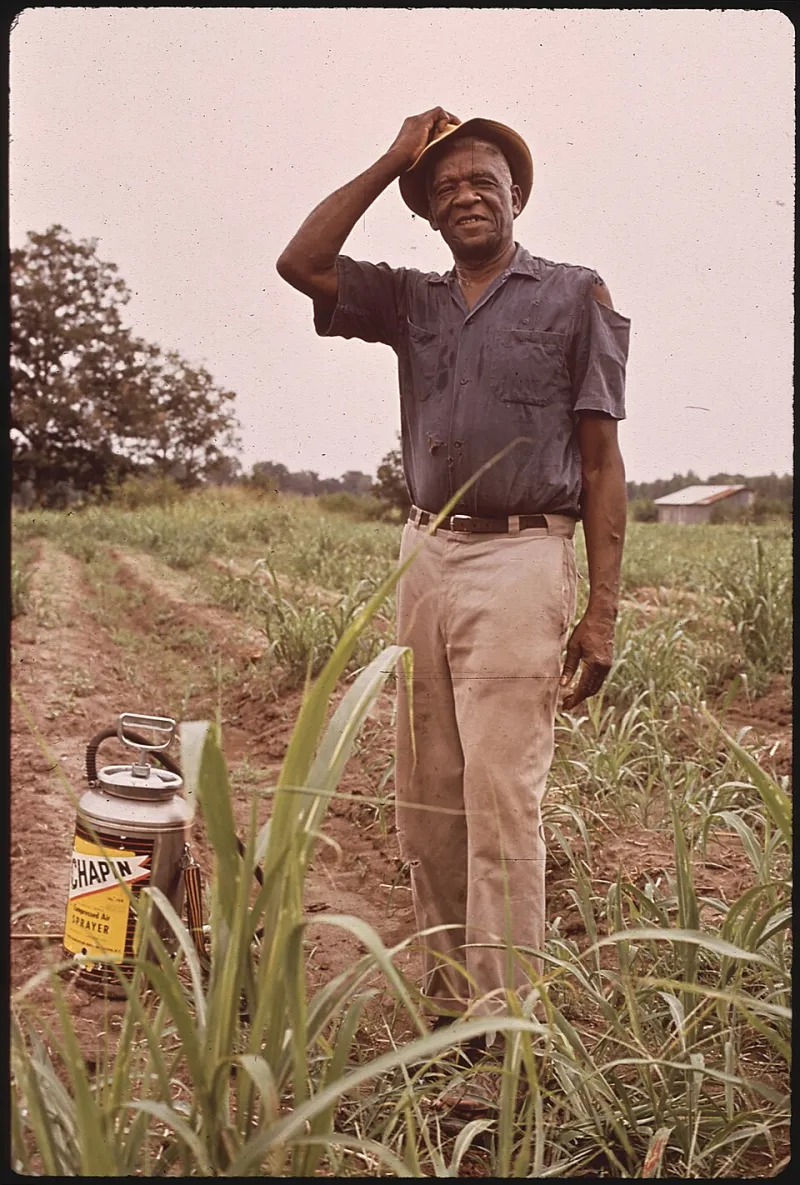
Photo: John Messina, Public domain, via Wikimedia Commons
A Controlled Environment and an Uncontrolled World
When a pesticide active ingredient moves through the EPA's registration process, it undergoes an extensive battery of toxicological and environmental fate studies. Acute and chronic mammalian toxicity, aquatic organism exposure, soil half-life, groundwater leaching potential—the data requirements are substantial, and the studies themselves are conducted under standardized, reproducible conditions. That standardization is not a flaw; it is a feature, enabling meaningful comparison across compounds and ensuring that registrants cannot cherry-pick favorable test conditions.
But standardization carries a cost. The conditions under which a pesticide is evaluated for registration are, by necessity, simplified versions of the world. The farms where those chemicals will ultimately be applied are not simple. They are defined by variability—in climate, soil composition, crop physiology, pest pressure, and the judgment calls of individual applicators. Understanding the distance between what EPA testing captures and what actually happens across American agricultural landscapes is not an exercise in regulatory criticism; it is a prerequisite for honest risk communication.
What Standard Testing Protocols Are Designed to Measure
The EPA's pesticide registration framework, governed primarily by the Federal Insecticide, Fungicide, and Rodenticide Act (FIFRA), requires applicants to submit data from studies that follow specific test guidelines—many developed in coordination with the OECD and other international bodies. These guidelines specify everything from the species used in ecotoxicology studies to the soil types employed in degradation experiments.
The resulting risk assessments are based on defined application scenarios: a single active ingredient, applied at label-specified rates, under controlled temperature and humidity, to a specified crop type. These scenarios are designed to represent a realistic worst case for exposure, not an average case. The logic is precautionary—if the compound passes under conservative assumptions, it should be safe under typical use.
That reasoning is sound as far as it goes. The complication arises when typical use in the field diverges from the scenarios the assessment was built around—and diverge it does, in ways that are both well-documented and underappreciated.
Tank-Mixing: The Common Practice That Testing Rarely Addresses
Among the most significant gaps between registration testing and field reality is the near-universal practice of tank-mixing. Farmers routinely combine multiple pesticide products—herbicides, insecticides, fungicides, and adjuvants—into a single spray solution to reduce application passes and labor costs. A 2021 survey conducted by the National Agricultural Statistics Service found that the majority of row crop producers apply at least two pesticide products simultaneously during a given growing season, and many use three or more in a single tank load.
EPA registration studies evaluate active ingredients individually. The agency does have provisions for assessing pesticide combinations in certain circumstances, but the sheer number of possible tank-mix permutations makes systematic pre-market evaluation impractical. The result is that synergistic or antagonistic interactions between co-applied compounds—effects that can meaningfully alter toxicity profiles, environmental persistence, or efficacy—are largely characterized after the fact, if at all.
Research published in journals including Environmental Science & Technology and Pest Management Science has documented cases where pesticide mixtures exhibit toxicity to non-target organisms at concentrations below the individual compounds' no-observed-effect levels. The mechanisms vary: some involve cytochrome P450 enzyme inhibition that slows metabolic breakdown of a co-applied compound; others reflect additive or synergistic action at shared biological targets. These interactions are real, measurable, and largely absent from the risk assessments that govern product use.
Environmental Variability and the Limits of Laboratory Soil Models
Pesticide fate and transport models used in EPA assessments rely on standardized soil parameters—organic matter content, pH, texture, and hydraulic conductivity values drawn from representative soil types. In practice, American farmland spans an enormous range of soil conditions, from the high-organic-matter mollisols of the Corn Belt to the sandy, low-retention soils common in parts of the Southeast and Pacific Northwest.
Soil organic matter content, in particular, has an outsized influence on pesticide sorption and degradation rates. A compound evaluated under the assumption of moderate organic matter content may behave very differently in a field with unusually low organic matter—moving more readily toward groundwater, persisting longer in the root zone, or becoming more bioavailable to soil organisms. Conversely, high-organic-matter soils may sequester certain compounds more aggressively than models predict, affecting both efficacy and the residue profiles that reach harvested crops.
Temperature and moisture variability compound these uncertainties further. Microbial degradation rates—a primary pathway for many pesticide active ingredients—are sensitive to soil temperature and water content. A half-life estimate derived from incubation studies conducted at 20°C and 40% moisture capacity may not translate cleanly to field conditions in Arizona in August or Minnesota in May.
Spray Timing, Drift, and the Applicator Variable
Label instructions specify application timing in general terms—pre-emergence, post-emergence, at specific growth stages—but they cannot fully account for the decision-making of individual applicators responding to real-time field conditions. Farmers adjust spray timing based on weather forecasts, equipment availability, pest scouting results, and economic considerations. These adjustments can meaningfully affect the exposure profiles of non-target organisms, including pollinators, beneficial insects, and adjacent aquatic systems.
Spray drift is another dimension that standard testing captures only partially. Drift modeling incorporated into EPA assessments uses defined meteorological parameters, but actual drift behavior is influenced by wind speed variability, nozzle selection, boom height, spray pressure, and droplet size distribution—variables that differ across equipment types and operator practices. Studies using real-world field measurements have consistently found drift deposition patterns that diverge from model predictions, sometimes substantially.
Toward More Adaptive Risk Assessment
Recognizing these limitations does not require abandoning the existing framework—it requires augmenting it. Several approaches have been proposed and, in some cases, piloted. Probabilistic risk assessment methods, which model exposure and effects as distributions rather than point estimates, can better capture the variability inherent in field conditions. Post-market monitoring programs, which track pesticide residues and ecological indicators in real agricultural landscapes, can provide feedback that refines pre-market assumptions over time.
The EPA has made incremental moves in this direction, including expanded use of geographic information system data in exposure modeling and increased attention to cumulative exposure assessments. Academic researchers and extension services at land-grant universities have contributed valuable field-scale data that can inform model calibration. However, the integration of this real-world evidence into the formal registration and re-evaluation process remains incomplete.
The goal is not perfect prediction—complex systems resist that ambition. It is, rather, a more honest accounting of what current assessments can and cannot tell us about the behavior of pesticides once they leave the laboratory and enter the living variability of American farmland.